

In an increasingly connected world, communication across languages is essential for building successful relationships, conducting international business, and accessing professional services. As Vietnam continues to strengthen its global presence, the demand for reliable Vietnamese interpreting services is growing across various industries.
Whether you are an international company working with Vietnamese partners, a foreign investor visiting Vietnam, a healthcare provider assisting Vietnamese-speaking patients, or an individual who needs language support for an important meeting, professional interpreting services can help eliminate communication barriers.
But what exactly are Vietnamese interpreting services? What types of interpreting are available, and how can you choose the right Vietnamese interpreter for your needs?
In this article, we will explore everything you need to know about professional Vietnamese interpreting services, their applications, benefits, and how to find a qualified interpreter.
1. What Are Vietnamese Interpreting Services?
Vietnamese interpreting services involve converting spoken communication between Vietnamese and another language, such as English, Chinese, Japanese, Korean, or French.
A professional Vietnamese interpreter helps individuals and organizations communicate accurately when they do not share the same language.
Unlike translation, which focuses on written documents, interpreting deals with spoken or signed communication. Interpreters must listen carefully, understand the speaker’s message, and convey it naturally and accurately in the target language.
For example, an American business representative attending a meeting with a Vietnamese manufacturing company may need a Vietnamese-English interpreter to facilitate discussions about product specifications, pricing, production schedules, and contractual conditions.
A qualified interpreter ensures that both parties understand the conversation and can make informed decisions.
Vietnamese interpreting services are commonly used in:
- International business meetings and negotiations.
- Conferences, seminars, and exhibitions.
- Factory visits and technical discussions.
- Medical consultations and hospital appointments.
- Legal consultations and administrative proceedings.
- Educational programs and training sessions.
- Government and diplomatic meetings.
- Telephone and online video conferences.
2. Why Are Vietnamese Interpreting Services Important?
Vietnam has become an important destination for international investment, manufacturing, trade, tourism, and business cooperation.
As more international organizations establish relationships with Vietnamese companies and individuals, the ability to communicate effectively in Vietnamese has become increasingly valuable.
Professional Vietnamese interpreting services offer several important advantages.
Eliminate Language Barriers
Language differences can create misunderstandings, delays, and unnecessary complications.
A professional interpreter ensures that information is communicated accurately, allowing participants to focus on the discussion rather than struggling with language differences.
Improve International Business Communication
Business negotiations often involve complex discussions about prices, contractual terms, technical requirements, and commercial expectations.
An experienced Vietnamese interpreter helps international companies communicate effectively with Vietnamese suppliers, customers, investors, and business partners.
Support Accurate Medical Communication
In healthcare environments, accurate communication is essential.
Vietnamese interpreters help healthcare professionals understand patients’ symptoms, medical histories, and concerns while helping Vietnamese-speaking patients understand medical explanations and treatment instructions.
Facilitate Legal and Administrative Procedures
Legal consultations and administrative procedures frequently involve specialized terminology and sensitive information.
Professional interpreters help participants understand important information while maintaining accuracy, neutrality, and confidentiality.
Build Trust and Stronger Relationships
Effective communication helps create trust between people from different linguistic and cultural backgrounds.
A professional interpreter does more than convert words. They help participants understand the context and intended meaning of conversations while respecting cultural differences.
3. Different Types of Vietnamese Interpreting Services
Depending on your requirements, Vietnamese interpreting services can be provided through several different interpreting methods.
Understanding these methods will help you select the most suitable service for your event or communication needs.
3.1. Consecutive Interpreting
Consecutive interpreting is one of the most widely used interpreting methods.
The speaker delivers a message and pauses while the interpreter conveys the information into the target language.
This method is suitable for:
- Business meetings.
- Contract negotiations.
- Interviews.
- Medical appointments.
- Small group discussions.
- Factory visits.
- Training sessions.
Example: Vietnamese-English Business Meeting
An Australian company is negotiating a supply agreement with a Vietnamese manufacturer.
During the meeting, the Australian representative explains the company’s product requirements, quality standards, and delivery expectations in English.
The Vietnamese interpreter listens carefully and then communicates the information in Vietnamese.
When the Vietnamese representative responds, the interpreter conveys the message into English.
This process allows both parties to communicate effectively without needing to speak each other’s language.
3.2. Simultaneous Interpreting
Simultaneous interpreting involves interpreting a speaker’s message into another language almost immediately while the speaker continues talking.
This method is commonly used at:
- International conferences.
- Large seminars.
- Government events.
- Multilingual business forums.
- International exhibitions.
- Professional training programs.
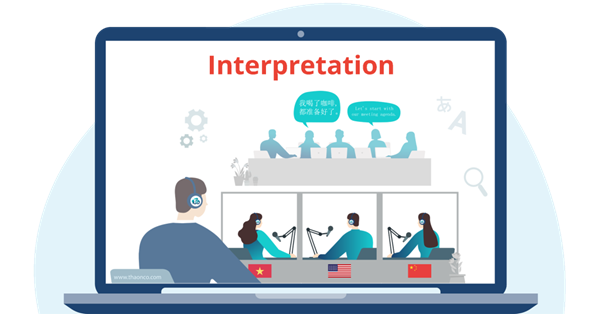
Simultaneous interpreters often work in soundproof booths equipped with microphones, headsets, and interpreting systems.
For example, an international conference in Ho Chi Minh City may include speakers presenting in English while Vietnamese participants listen to the Vietnamese interpretation through wireless headsets.
This method is particularly useful when an event involves many participants and requires continuous communication.
3.3. Whispered Interpreting
Whispered interpreting, also known as chuchotage, is a form of simultaneous interpreting in which the interpreter quietly translates the speaker’s message directly to one or a small number of listeners.
It is suitable for:
- Business delegations.
- International visitors.
- Small meetings.
- Factory tours.
- Private presentations.
For example, a foreign investor attending a business presentation in Vietnam may need a Vietnamese interpreter to whisper the Vietnamese interpretation into their ear while the presenter speaks.
3.4. Telephone Interpreting
Telephone interpreting allows people who speak different languages to communicate through a telephone connection with the assistance of an interpreter.
It is useful when immediate language support is required but an in-person interpreter is unavailable or unnecessary.
Common applications include:
- Customer service calls.
- Business discussions.
- Appointment scheduling.
- Initial consultations.
- General inquiries.
3.5. Video Remote Interpreting
Video remote interpreting allows participants and interpreters to communicate through online video conferencing platforms.
This service is increasingly popular because it provides flexibility and reduces the need for travel.
Video remote Vietnamese interpreting is suitable for:
- Online business meetings.
- Virtual consultations.
- International interviews.
- Remote training sessions.
- Online conferences.
- Cross-border customer support.
Participants can communicate from different locations while receiving professional language assistance.
4. Industries That Need Vietnamese Interpreting Services
Vietnamese interpreting services are used across many industries. Each sector requires interpreters with appropriate language proficiency and subject-specific knowledge.
Business, Trade, and Investment
International companies working with Vietnamese partners frequently require interpreting support for commercial activities.
Typical assignments include:
- Business negotiations.
- Investment discussions.
- Supplier meetings.
- Factory inspections.
- Product presentations.
- Partnership agreements.
- Corporate training.
Practical example:
A Japanese company plans to establish a manufacturing partnership in Vietnam.
During meetings with local management, a Vietnamese-Japanese interpreter facilitates communication about investment plans, production capacity, labor requirements, technical specifications, and operational procedures.
Accurate interpreting helps both parties understand their responsibilities and expectations.
Manufacturing and Engineering
Vietnam is an important manufacturing destination for companies operating in electronics, textiles, furniture, machinery, and other industrial sectors.
Foreign engineers and technical specialists may require Vietnamese interpreters when working with local employees.
Common assignments include:
- Factory inspections.
- Equipment installation.
- Technical training.
- Production process explanations.
- Quality control discussions.
- Workplace safety instructions.
In these situations, interpreters should understand relevant technical terminology to communicate instructions accurately.
Healthcare and Medical Services
Medical interpreting helps healthcare providers communicate with patients who speak Vietnamese.
Typical situations include:
- Hospital consultations.
- Medical examinations.
- Diagnostic discussions.
- Treatment explanations.
- Health insurance consultations.
- Medical follow-up appointments.
For example, a Vietnamese patient receiving treatment at a hospital overseas may require a Vietnamese-English interpreter to communicate with doctors and nurses.
Medical interpreters must understand healthcare terminology, maintain confidentiality, and follow professional boundaries. They should not independently provide medical advice or replace healthcare professionals.
Legal and Immigration Services
Legal and immigration matters often involve complex terminology and important personal information.
Vietnamese interpreting services may be required for:
- Lawyer-client meetings.
- Immigration interviews.
- Legal consultations.
- Administrative procedures.
- Contract discussions.
- Official appointments.
Interpreters working in these settings must maintain neutrality and accurately convey all relevant information.
Certain legal assignments may require interpreters with specific qualifications or authorization under local regulations.
Tourism and Hospitality
Vietnam welcomes international visitors for business, leisure, and cultural experiences.
Hotels, travel agencies, tour operators, and tourism organizations may need Vietnamese interpreters to assist international guests and Vietnamese-speaking service providers.
Interpreting can support:
- Guided tours.
- Travel arrangements.
- Business travel.
- Cultural exchange programs.
- Hospitality events.
- International tourism conferences.
Education and Training
Educational institutions and international organizations often organize multilingual activities involving Vietnamese-speaking participants.
Professional interpreters can support:
- International workshops.
- Academic conferences.
- Student exchange programs.
- Professional training.
- University meetings.
- Research presentations.
5. What Makes a Good Vietnamese Interpreter?
Not everyone who speaks Vietnamese and another language is automatically qualified to work as a professional interpreter.
Interpreting requires a combination of language skills, technical knowledge, communication abilities, and professional ethics.
Here are some essential qualities to look for.
Excellent Language Proficiency
A professional Vietnamese interpreter should have a strong command of both the source and target languages.
They must understand different accents, expressions, speaking styles, and cultural references.
Subject-Matter Knowledge
Industry knowledge is especially important for specialized assignments.
For example, an interpreter working at a factory inspection should understand manufacturing terminology, while an interpreter assisting with medical consultations should be familiar with relevant healthcare vocabulary.
Strong Listening and Memory Skills
Interpreters must process information quickly and accurately.
Good listening and memory skills help them retain important details, including names, numbers, dates, technical terms, and key messages.
Cultural Awareness
Vietnamese communication styles may differ from those used in English-speaking or other international environments.
A culturally aware interpreter understands these differences and communicates the intended meaning naturally while remaining faithful to the speaker’s message.
Professional Ethics and Confidentiality
Interpreters may handle confidential business, legal, medical, and personal information.
They must maintain impartiality, protect sensitive information, and avoid conflicts of interest.
Adaptability and Professionalism
Every interpreting assignment is different.
A good interpreter should be punctual, well-prepared, flexible, and capable of working under pressure.
6. How to Choose the Right Vietnamese Interpreting Service Provider
Selecting the right interpreting provider is important because the quality of interpretation can directly affect communication outcomes.
Before hiring a Vietnamese interpreting service provider, consider the following factors.
1. Check Language Qualifications and Experience
Ask about the interpreter’s language proficiency, professional background, and experience with similar assignments.
For specialized projects, look for interpreters with relevant industry knowledge.
2. Choose the Appropriate Interpreting Method
Different situations require different interpreting techniques.
For example:
- Consecutive interpreting is suitable for business meetings and consultations.
- Simultaneous interpreting is ideal for large conferences.
- Whispered interpreting works well for small groups.
- Remote interpreting is convenient for online meetings.
- Telephone interpreting is useful for quick conversations.
Discuss your requirements with the provider before confirming the service.
3. Consider Industry Specialization
If your assignment involves technical, medical, legal, or financial terminology, choose an interpreter who is familiar with that particular field.
Industry-specific knowledge helps reduce misunderstandings and improves communication quality.
4. Ask About Preparation and Equipment
Professional interpreters may need advance materials to prepare for an assignment.
These materials can include:
- Meeting agendas.
- Presentation slides.
- Technical documents.
- Company profiles.
- Product information.
- Glossaries and terminology lists.
For simultaneous interpreting, confirm whether the provider can arrange the necessary equipment, such as interpreter booths, microphones, and headsets.
5. Confirm Confidentiality and Service Conditions
Before hiring an interpreting provider, clarify confidentiality arrangements, scheduling, working hours, cancellation policies, and any additional service requirements.
A professional provider should communicate these conditions clearly.
7. How to Prepare for a Vietnamese Interpreting Assignment
Good preparation is essential for successful interpreting.
Both clients and interpreters have important roles in ensuring that communication runs smoothly.
If you are organizing a meeting or event that requires Vietnamese interpreting services, consider the following recommendations.
Provide Background Information
Share the purpose of the assignment, participants’ names, company information, and relevant industry details.
Prepare Meeting Materials
Send presentation slides, agendas, technical documents, or discussion topics to the interpreter in advance whenever possible.
Explain the Interpreting Format
Confirm whether the assignment requires consecutive, simultaneous, whispered, telephone, or video remote interpreting.
Allow Time for Interpretation
During consecutive interpreting, speakers should pause regularly to allow the interpreter to convey the message accurately.
Speak Clearly and Naturally
Avoid speaking too quickly or using unnecessary abbreviations and unexplained technical expressions.
Test Technical Equipment
For remote and simultaneous interpreting, check microphones, internet connections, headsets, and conferencing platforms before the event begins.
These simple steps can significantly improve the overall interpreting experience.
8. Vietnamese-English Interpreting: A Growing Need for International Communication
Among the different language combinations, Vietnamese-English interpreting plays an important role in international communication.
English is widely used in international business, education, technology, tourism, and professional cooperation. At the same time, Vietnamese remains essential when communicating with local companies, employees, customers, and communities.
Vietnamese-English interpreters help bridge this language gap.
Consider the following practical scenarios:
Scenario 1: Foreign Investors Meeting Vietnamese Business Partners
An American investor visits Vietnam to discuss a potential investment project with a local company.
A Vietnamese-English interpreter facilitates the conversation about business objectives, investment conditions, financial expectations, and project timelines.
Scenario 2: International Buyers Visiting Vietnamese Factories
A European buyer visits a textile factory in Vietnam to evaluate production capacity and quality control procedures.
The interpreter helps the buyer communicate with factory managers, engineers, and production staff.
Scenario 3: International Medical Consultations
A Vietnamese-speaking patient needs assistance communicating with English-speaking healthcare professionals.
A Vietnamese-English medical interpreter helps both parties exchange important healthcare information.
Scenario 4: International Conferences in Vietnam
An organization hosts a conference in Hanoi with speakers from several countries.
Professional Vietnamese-English interpreters help participants follow presentations, ask questions, and participate in discussions.
These examples demonstrate the importance of reliable Vietnamese-English interpreting in both professional and everyday situations.
9. In-Person vs. Remote Vietnamese Interpreting Services
One important consideration when selecting an interpreting solution is whether you need an in-person interpreter or remote language support.
Both options have advantages depending on the nature of the assignment.
| Criteria | In-Person Interpreting | Remote Interpreting |
|---|---|---|
| Location | Interpreter attends physically | Interpreter joins online or by phone |
| Interaction | Direct face-to-face communication | Communication through technology |
| Suitable for | Factory visits, conferences, negotiations | Online meetings, consultations, interviews |
| Travel | May involve travel arrangements | Usually no travel required |
| Flexibility | Depends on location and schedule | Often more flexible |
| Equipment | May require microphones or headsets | Requires suitable devices and connectivity |
Which option should you choose?
In-person interpreting is generally preferable when physical presence, direct interaction, or on-site support is important.
Remote interpreting is a convenient alternative when participants are in different locations or need language support for online communication.
The best solution depends on your objectives, event format, technical requirements, and budget.
10. Why Choose a Professional Vietnamese Translation and Interpreting Provider?
Working with a professional language service provider can make organizing an interpreting assignment easier and more efficient.
A reliable provider can help you identify the appropriate interpreting method, arrange qualified language professionals, and coordinate the requirements of your project.
When evaluating a Vietnamese interpreting service provider, look for:
- Experienced Vietnamese interpreters.
- Multiple language combinations.
- Industry-specific interpreting capabilities.
- Flexible scheduling arrangements.
- In-person and remote service options.
- Clear communication and service conditions.
- Appropriate confidentiality practices.
Whether you are organizing a small business meeting or a large international conference, choosing the right interpreting partner can help ensure smooth and effective communication.
Frequently Asked Questions About Vietnamese Interpreting Services
1. What are Vietnamese interpreting services?
Vietnamese interpreting services involve converting spoken communication between Vietnamese and another language, such as English, Chinese, Japanese, or Korean. They help people communicate effectively in business, healthcare, legal, educational, and other professional environments.
2. What is the difference between Vietnamese translation and interpreting?
Vietnamese translation focuses on written materials, including contracts, websites, reports, and manuals.
Vietnamese interpreting focuses on spoken or signed communication, allowing people who speak different languages to understand each other during conversations, meetings, and events.
3. How much do Vietnamese interpreting services cost?
The cost depends on several factors, including:
- Language combination.
- Interpreting method.
- Assignment duration.
- Subject complexity.
- Location and travel requirements.
- Equipment and technical arrangements.
For an accurate quotation, provide the service provider with your assignment details, date, location, language combination, and expected duration.
4. Can I book a Vietnamese interpreter for an online meeting?
Yes. Remote Vietnamese interpreting services can support online meetings through suitable video conferencing or telephone platforms.
This is a convenient option for international businesses and individuals who need language support without arranging an in-person interpreter.
5. Do I need to provide documents before an interpreting assignment?
Providing relevant documents in advance is highly recommended.
Meeting agendas, presentation slides, technical materials, and terminology lists help interpreters prepare for the assignment and understand its subject matter.
6. Are Vietnamese interpreters available for specialized industries?
Yes. Depending on the provider’s capabilities, interpreters may be available for business, manufacturing, engineering, healthcare, legal, tourism, and other specialized fields.
Always confirm the interpreter’s relevant experience before booking.
7. How far in advance should I book a Vietnamese interpreter?
It is best to arrange interpreting services as early as possible, especially for conferences, simultaneous interpreting, specialized assignments, or projects requiring travel and equipment.
Early booking allows sufficient time for interpreter selection, preparation, and coordination.
Conclusion: Find the Right Vietnamese Interpreting Services for Your Needs
Professional Vietnamese interpreting services play an essential role in connecting people, businesses, and organizations across language and cultural boundaries.
From international business negotiations and factory visits to medical consultations and conferences, qualified interpreters help ensure that important information is communicated accurately and effectively.
When selecting an interpreting provider, consider language proficiency, professional experience, industry specialization, interpreting methods, and confidentiality standards.
If you are looking for professional Vietnamese interpreting services, Vietnamese Translation Services can help you explore suitable language solutions for your communication needs.
Whether you require Vietnamese-English interpreting for a business meeting, consecutive interpreting for a factory visit, simultaneous interpreting for an international conference, or remote interpreting for an online consultation, contact our team to discuss your requirements.
Vietnamese Translation Services – Your Trusted Partner for Vietnamese Language Solutions.
Contact us today to request a quotation and find the right interpreting solution for your next project.
