

The information technology (IT) industry is one of the fastest-growing sectors in the world. As technology companies expand across borders, the demand for professionals who can communicate technical information accurately in different languages continues to increase.
This has created exciting opportunities for IT interpreters, who help bridge communication gaps between IT professionals, businesses, developers, engineers, and international clients.
If you have strong language skills and an interest in technology, becoming an IT interpreter can be a rewarding career choice. But what does it take to become a successful IT interpreter?
In this article, we will explore the essential steps, skills, and qualifications needed to build a career in IT interpreting.
What Is an IT Interpreter?
An IT interpreter is a language professional who provides real-time interpretation for conversations and events related to information technology.
Unlike general interpreters, IT interpreters need to understand technical terminology and concepts so they can accurately communicate between speakers.
An IT interpreter may work in situations such as:
- Business meetings between technology companies
- Software development meetings
- IT conferences and seminars
- Technical training sessions
- Product demonstrations
- Client consultations
- Remote meetings between international teams
- Technical support discussions
- Software and hardware presentations
The interpreter’s role is not simply to translate individual words. They must understand the context and communicate the intended meaning clearly and accurately.
Step 1: Develop Strong Language Skills
The first requirement for becoming an IT interpreter is strong proficiency in at least two languages.
You should have excellent listening, speaking, reading, and comprehension skills in both your source and target languages.
For example, an interpreter working between Vietnamese and English should be comfortable communicating professionally in both languages.
However, conversational fluency alone is not enough. Professional interpreting requires the ability to:
- Understand speakers with different accents
- Process information quickly
- Identify the main message
- Use appropriate terminology
- Speak clearly and naturally
- Adapt to different communication styles
Building a strong vocabulary in both languages is an important first step toward becoming a professional interpreter.
Step 2: Learn IT Terminology
Language proficiency is only part of the job. An IT interpreter must also understand the terminology commonly used in the technology industry.
Depending on your specialization, you may need to become familiar with terms related to:
- Software development
- Cloud computing
- Artificial intelligence
- Cybersecurity
- Data science
- Networking
- Databases
- Hardware
- Mobile applications
- Web development
- DevOps
- Information systems
You do not necessarily need to become a software engineer. However, understanding basic IT concepts can significantly improve your interpreting accuracy.
For example, an interpreter should understand the difference between terms such as “server,” “database,” “API,” “framework,” “deployment,” and “cloud computing” rather than simply memorizing their translations.
Step 3: Choose an IT Specialization
The IT industry is broad, so it can be helpful to develop expertise in a specific area.
Instead of trying to master every technology field, consider choosing one or two areas that interest you.
For example, you could specialize in:
Software Development:
Focus on programming languages, software architecture, application development, and development processes.
Cybersecurity:
Learn terminology related to network security, data protection, authentication, vulnerabilities, and security systems.
Cloud Computing:
Become familiar with cloud infrastructure, virtualization, cloud services, and platforms.
Artificial Intelligence:
Learn terminology related to machine learning, neural networks, natural language processing, and generative AI.
Developing a specialization can make you more competitive and help you build a strong professional reputation.
Step 4: Develop Interpreting Skills
Knowing two languages and IT terminology does not automatically make someone a good interpreter.
Interpreting requires specialized skills that should be developed through practice and training.
Important interpreting skills include:
Active Listening
Interpreters must listen carefully while processing information and preparing to communicate it in another language.
Note-Taking
For consecutive interpreting, effective note-taking can help interpreters remember names, numbers, technical terms, and key points.
Quick Thinking
IT meetings can move quickly. Interpreters need to process information and respond without unnecessary delays.
Memory
Interpreters often need to retain information for several seconds or longer before delivering the message in the target language.
Public Speaking
Confidence and clear pronunciation are essential, particularly when interpreting at conferences, presentations, or large meetings.
Step 5: Get Professional Training
Formal education is not always mandatory, but professional interpreter training can provide a significant advantage.
Consider taking courses in:
- Conference interpreting
- Consecutive interpreting
- Simultaneous interpreting
- Technical translation
- Business communication
- IT terminology
- Professional ethics
A degree or certificate in translation and interpreting can also help demonstrate your professional qualifications to potential clients and employers.
If you already have a background in IT, additional training in interpreting may be particularly valuable. Likewise, language professionals can benefit from gaining formal knowledge of IT.
Step 6: Practice With Real IT Content
One of the most effective ways to improve is to practice with authentic IT materials.
You can watch technology conferences, product demonstrations, webinars, technical presentations, and interviews in your working languages.
Try interpreting the speaker’s message aloud while listening.
You can also create your own terminology glossary containing:
- English terms
- Vietnamese equivalents
- Definitions
- Example sentences
- Related terms
- Common abbreviations
Regular practice will help you become faster and more confident when dealing with technical subjects.
Step 7: Gain Practical Experience
Experience is one of the most valuable assets for an interpreter.
At the beginning of your career, look for opportunities to interpret:
- Small business meetings
- Online conferences
- Training sessions
- Technology events
- Internal company meetings
- Interviews
- Product demonstrations
Working on smaller assignments allows you to develop your skills before taking on more complex projects.
You should also ask for feedback after each assignment. Constructive feedback can help you identify problems with terminology, pronunciation, delivery, or interpreting technique.
Step 8: Learn Interpreting Technology
Modern interpreters increasingly work remotely, so familiarity with digital tools is becoming essential.
IT interpreters may need to work with:
- Video conferencing platforms
- Remote interpreting platforms
- Digital glossaries
- Terminology management tools
- Headsets and microphones
- Screen-sharing tools
- Collaboration platforms
Technical problems can affect an interpreting session, so interpreters should understand how to test their equipment and maintain a reliable working environment.
Step 9: Build a Professional Portfolio
Once you have gained some experience, create a professional portfolio.
Your portfolio can include:
- Language combinations
- Areas of specialization
- Professional qualifications
- Relevant work experience
- Types of interpreting services offered
- Technical fields you understand
- Client testimonials, when available
For confidentiality reasons, never include sensitive client information or proprietary documents without permission.
A professional online profile can also make it easier for companies and agencies to find you.
Step 10: Continue Learning
Technology changes rapidly. New programming frameworks, software platforms, AI tools, security threats, and technical concepts appear constantly.
Therefore, an IT interpreter should treat learning as an ongoing process.
Follow technology news, attend webinars, read technical documentation, and regularly update your terminology database.
The stronger your understanding of the IT industry becomes, the more accurately you can interpret complex discussions.
What Skills Make a Good IT Interpreter?
A successful IT interpreter typically combines three areas of expertise:
Language skills + interpreting skills + IT knowledge
Having only one or two of these areas may not be enough.
For example, a person with excellent English may struggle to interpret a cybersecurity meeting without understanding cybersecurity terminology. Similarly, an IT professional may understand the technical discussion but lack the language and interpreting skills required to communicate it accurately.
The strongest IT interpreters develop all three areas together.
Is IT Interpreting a Good Career?
IT interpreting can be an attractive career for people who enjoy both languages and technology.
The work can offer opportunities to collaborate with international companies, attend technology events, work remotely, and specialize in rapidly developing fields.
However, it can also be demanding. Interpreters need to concentrate for long periods, process information quickly, and continuously update their knowledge.
For professionals who enjoy learning and working in multicultural environments, these challenges can also make the career highly rewarding.
Final Thoughts
Becoming an IT interpreter requires more than simply speaking two languages. You need strong language skills, professional interpreting techniques, and a solid understanding of information technology.
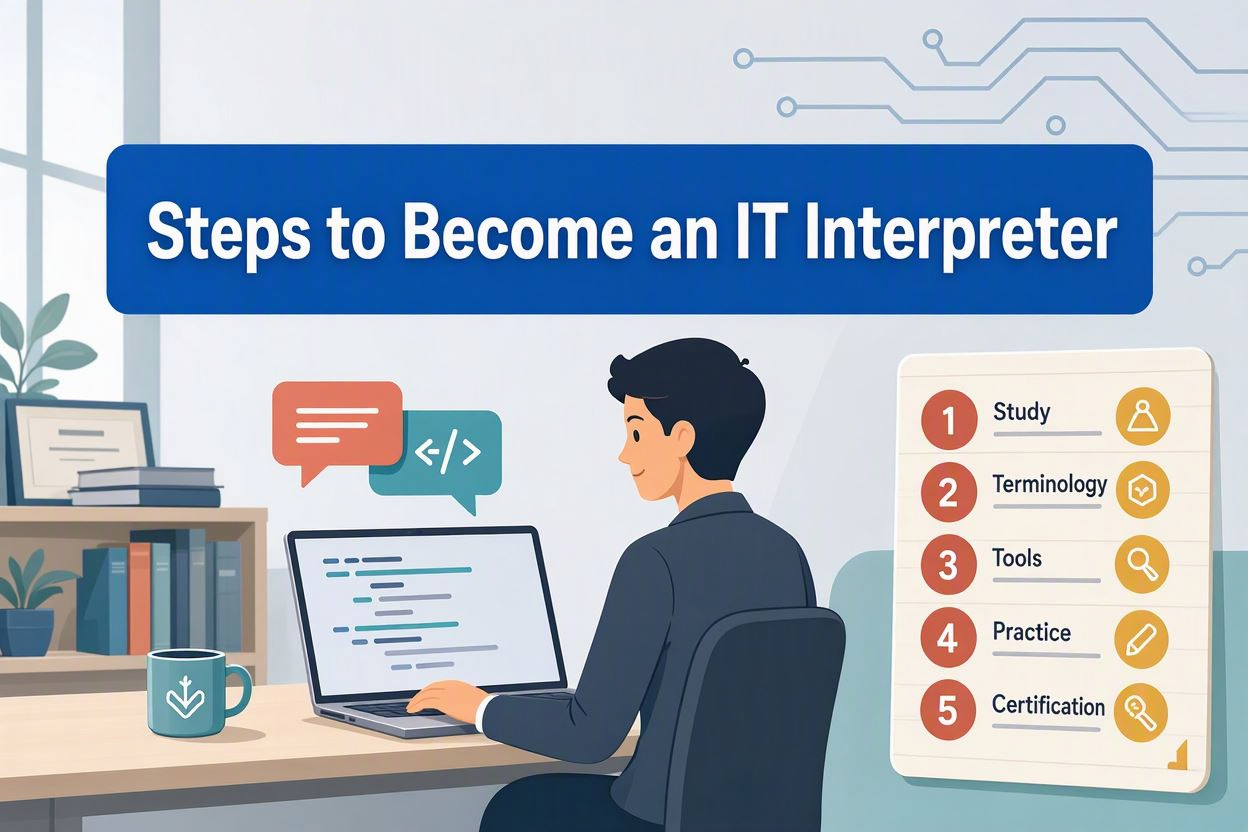
The journey can be summarized in a few essential steps:
- Develop strong language skills.
- Learn IT terminology and concepts.
- Choose an IT specialization.
- Develop professional interpreting skills.
- Obtain relevant training and qualifications.
- Practice with authentic IT content.
- Gain practical interpreting experience.
- Learn to use modern interpreting technology.
- Build a professional portfolio.
- Continue learning as technology evolves.
With consistent practice and a commitment to professional development, language professionals can build valuable expertise in IT interpreting and serve the growing needs of international technology businesses.
If your company needs professional IT interpreting or Vietnamese-English interpretation services, working with an experienced language service provider can help ensure that technical information is communicated accurately, clearly, and professionally.
